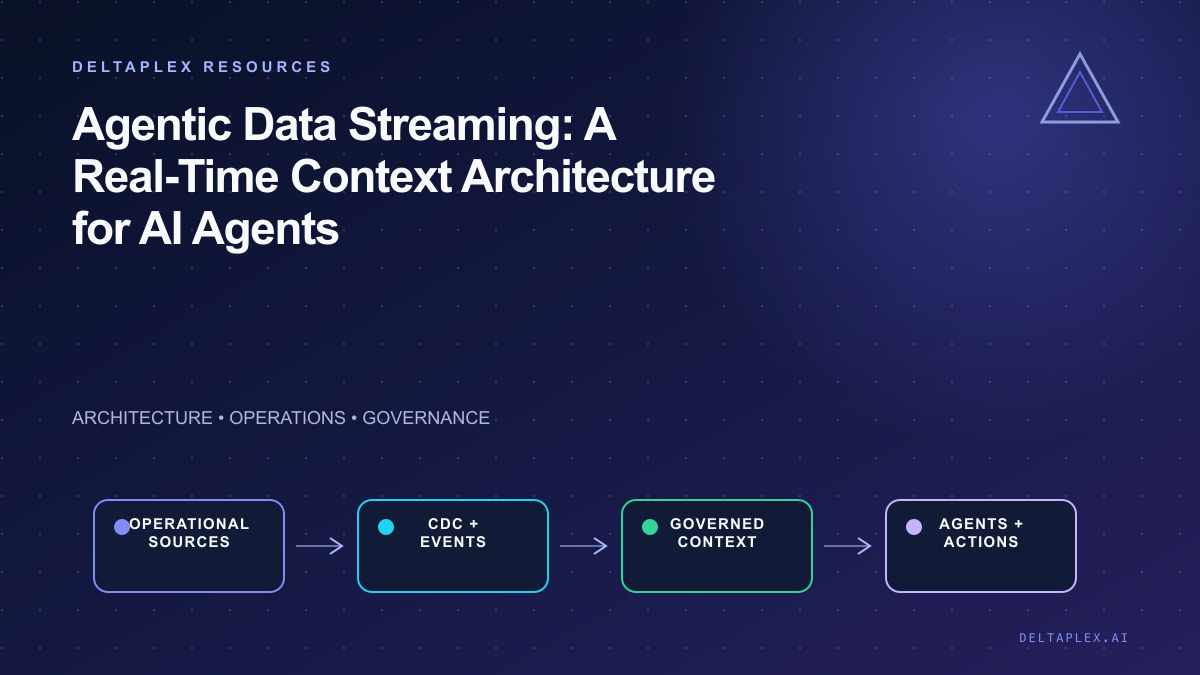
What is agentic data streaming?
Agentic data streaming is an architecture pattern that continuously delivers fast-changing operational signals to AI agents as governed, traceable context. It combines change data capture or business events with processing, context serving, identity, policy, replay, and action audit. It does not make every dataset real time, replace RAG, or justify direct agent access to production databases.
How does agentic data streaming work?
Agentic data streaming is the controlled flow of operational changes into an agent's decision loop. The important word is not only streaming; it is agentic. The data may influence a recommendation, initiate a workflow, request human approval, or cause an external action. That makes freshness only one requirement. The path must also preserve meaning, identity, provenance, failure state, and evidence of what happened next.
The pattern can be described as six steps: observe, contextualize, decide, approve, act, and record. A source system commits a change or emits a business event. A capture layer moves the signal without repeatedly scanning the source. Processing applies routing, schema, quality, and policy rules. A context service makes the result usable by an agent. The agent proposes or takes an action within a defined authority. The system then records the input, decision, approval, outcome, and recovery state.
This is broader than event streaming. Event streaming transports and distributes events. Stream processing transforms them. Change data capture, or CDC, captures committed database changes. Agentic data streaming combines those capabilities with the controls needed when software can act. It is an architecture pattern, not a single protocol or product category.
Why are batch pipelines, static RAG, and direct source queries insufficient on their own?
Batch, retrieval-augmented generation, and live queries each solve useful problems. The mistake is to ask one of them to represent every kind of enterprise context.
Batch is right when the decision window is long
Batch remains appropriate for historical reporting, model training, periodic planning, and reference data whose business value changes slowly. It becomes a problem when a decision can change between refreshes. A payment risk signal, stock reservation, delivery exception, or service outage may lose most of its value in minutes. The relevant test is not whether real time sounds modern. It is whether a late signal changes the decision or its cost.
Static RAG is knowledge, not current state
RAG is effective for policies, manuals, contracts, research, and other document-shaped knowledge. A vector index refreshed on a schedule is not automatically the authoritative state of an account, order, machine, or claim. Indexing also introduces separate questions about deletion, permissions, versioning, and staleness. An agent often needs both: retrieved knowledge to understand rules, and operational context to understand what is true now.
Direct queries trade freshness for a larger operational boundary
A narrow, low-frequency query to a well-protected service can be appropriate. Broad database credentials and unconstrained SQL are not a sensible default. As agent concurrency grows, direct access can increase production load, widen credential exposure, create inconsistent multi-source reads, and make audit difficult. A governed context service or materialized operational view usually creates a safer boundary.
| Context type | Best starting pattern | Primary risk |
|---|---|---|
| Policies and manuals | RAG with versioned documents | Outdated or over-broad retrieval |
| Historical aggregates | Batch or warehouse query | Refresh delay |
| Fast-changing business state | CDC or business events | Ordering, duplicates, schema change |
| Authoritative current field | Controlled pull through a service | Source load and authorization |
| Action trigger plus current detail | Hybrid push and pull | State changing between trigger and action |
Which enterprise signals actually need real-time delivery?
Freshness should be derived from value decay. Ask how long a signal can be delayed before a materially different decision is made. The answer may be seconds for suspected payment fraud, minutes for stock allocation, hours for a support escalation, and a day for a supplier reference record.
| Freshness class | Illustrative signals | Delivery pattern | Key control |
|---|---|---|---|
| Sub-second to seconds | Payment anomaly, machine safety state | Push, usually with a fast context lookup | Deduplication and bounded automated action |
| Seconds to minutes | Inventory reservation, logistics exception | Hybrid event trigger and pull | Entity ordering and version check |
| Minutes to hours | Customer case priority, operational risk indicator | Stream or micro-batch | End-to-end freshness monitoring |
| Daily or slower | Reference data, long-horizon planning inputs | Batch | Completeness and version control |
A useful freshness service-level objective measures the entire path from source commit to agent availability. Connector lag alone can look healthy while processing, context assembly, or serving is delayed. Teams should track source commit time, capture time, context availability time, context age at decision, late-event rate, and the number of decisions made with stale context.
What does a production reference architecture look like?
A practical architecture has five layers and a control plane that crosses all of them.
1. Operational sources
These are systems of record, applications, brokers, devices, and external services. The design should distinguish business event time from database commit time and observation time. Source protection is a first-order constraint: an agent initiative should not create an unbounded analytical workload on a production system.
2. CDC and event capture
Log-based CDC is appropriate when committed database state matters and repeated queries would be disruptive. Application events may carry richer business intent. Polling can still work for small, low-frequency sources. The capture record should preserve source position, transaction boundary, schema version, and timestamps. CDC does not, by itself, supply business semantics or agent authorization.
3. Governed delivery and processing
This layer filters, routes, masks, enriches, validates, and applies data contracts. It handles incompatible schema changes, slow consumers, and backpressure. A raw row change should not automatically become an agent instruction. Processing converts technical changes into context events whose meaning and permitted use are explicit.
4. Context serving
The serving layer may be an event store, operational cache, feature store, graph, vector system, API, or a combination. Context should carry its source, age, transformation version, policy classification, and expiry. Multi-source context also needs a stated consistency model: a perfectly fresh field joined to yesterday's profile is not a coherent current view.
5. Agents and actions
The runtime consumes context, invokes tools, requests approval, and records outcomes. Recommendations, reversible internal changes, and irreversible external actions should have different authority. Identity, policy, lineage, observability, checkpoints, and approval form the cross-cutting control plane.
Should agents receive context by push, pull, or a hybrid pattern?
Push is best when a small number of high-value changes must trigger rapid attention. It avoids polling but introduces event storms, duplicate triggers, and actions based on an event that is already outdated. Use routing, throttling, priority, deduplication, and expiry.
Pull is best when the agent needs a narrow, authoritative answer at decision time. It limits copied data but places availability and authorization pressure on the serving path. Put a controlled API or context service between the agent and the source, restrict query shape and field scope, and set timeouts and quotas.
Hybrid is often the strongest production starting point. A small event wakes the workflow and identifies the affected entity. The agent then retrieves only the current fields required for the decision. An event ID, entity ID, source version, and as-of time connect the two steps. This reduces sensitive data in the trigger while checking that the state has not moved on.
How should ordering, idempotency, replay, and source protection work?
Most systems cannot promise meaningful global order across every entity and partition. What usually matters is order within an account, order, shipment, or other aggregate. Select the key deliberately and document what happens when events from different sources arrive at different times.
Retries create duplicates. Each trigger, tool call, and business action therefore needs an idempotency boundary. The event identifier can prevent duplicate context processing, while a business key may prevent a refund, notification, or order from being executed twice. These are not the same control.
Replay is essential for recovery and for adding a new consumer, but replaying data must not automatically repeat external side effects. Separate reprocessing context from re-executing action. Store checkpoints and action outcomes, and require a new authorization decision before an old event can produce a new external action.
Protect source systems with low-impact capture where appropriate, connection limits, backpressure, caches, materialized context, and circuit breakers. If the serving layer falls behind, pause or shed non-critical consumers instead of allowing pressure to propagate invisibly to the source.
How do identity, policy, lineage, and human approval travel with the data?
An agent needs its own workload identity and a bounded delegated authority. It should not inherit a shared human administrator account. The system should be able to distinguish the end user, the agent, the service that exposed a tool, the approver, and the system that accepted the action.
Context should be linked to source, timestamp, schema, processing, and policy versions. Decision evidence should connect that context to the agent or model version, tool call, approval, action result, and rollback state. Because logs can contain personal or confidential information, evidence also needs minimization, access control, and retention rules.
Approval should match action risk. A read-only recommendation may be automatic and sampled later. A reversible internal update may run within thresholds. A financial, external, security-sensitive, or irreversible action may require approval before execution. The control must run outside the model; a prompt instruction is not an authorization boundary.
What failure modes must the architecture handle?
- Stale but healthy: every process is running, but the context is older than the decision allows. Detect end-to-end age, not only process health.
- Duplicate or out-of-order: a retry repeats an action or an older event overwrites a newer state. Use entity versions, idempotency, and explicit conflict handling.
- Context-action split: the state changes between retrieval and execution. Recheck the version or use optimistic concurrency before committing the action.
- Schema or policy drift: the pipeline still moves bytes while their meaning or permitted use has changed. Stop or quarantine incompatible changes.
- Approval timeout: the agent waits indefinitely or acts after a decision has expired. Give approvals an expiry and a defined fallback.
- Target outage: context delivery stops or backlogs. Bound queues, prioritize critical signals, and test recovery and reconciliation.
For each failure, document how to detect it, contain it, recover, and prove what happened. Recovery is incomplete until the team can reconcile source state, delivered context, and external actions.
How can a team run a 90-day production pilot?
Days 1–30: bound the workflow. Choose one valuable, reversible use case. Identify the systems of record, forbidden actions, decision owner, and human fallback. Measure current delay, manual effort, source load, error rate, and incident frequency. Define freshness, correctness, safety, and business outcomes before building.
Days 31–60: build and break the path. Connect one or two sources, define the context contract, establish workload identity, and implement a hybrid push-pull path. Run in shadow mode. Inject duplicates, out-of-order events, schema changes, network interruption, downstream outage, and approval rejection. Confirm that the workflow fails closed or becomes read-only.
Days 61–90: limit production and decide. Restrict the user group, entities, and actions. Compare agent proposals with human decisions and actual outcomes. Track stale decisions, duplicate actions, recovery time, source impact, approval volume, and evidence completeness. Use written exit criteria to expand, redesign, or stop.
Which production trade-offs should be explicit?
A production architecture should state what it is optimizing and what it is willing to trade. Lower latency can require smaller batches, more connections, more frequent commits, and more operational cost. Richer context can improve a decision while increasing data exposure, assembly time, and the number of sources that must be available. Longer replay windows improve recoverability while increasing storage, retention, and policy complexity. Teams should make these choices visible rather than hiding them behind the word real-time.
Consumer isolation is another deliberate choice. One slow agent workflow should not delay a fraud signal, inventory update, or other critical consumer. Separate queues, priorities, quotas, and failure domains according to business impact. Define which consumers may be shed during pressure and which must retain reserved capacity. The same principle applies to context enrichment: optional data should not block delivery of the minimum safe context.
Finally, define the degradation path before launch. If enrichment is unavailable, the agent may receive a smaller context, switch to read-only, or route the task to a human. If freshness cannot be proven, the system should not silently continue with an old value. Production readiness means knowing which reduced service is safe, how it is detected, and who can restore full authority.
Where does Deltaplex fit—and where does it not?
Fit
Deltaplex is relevant when the architectural need is a governed path for moving operational changes from source systems toward analytics, context services, or agent workflows. The evaluation should focus on the exact sources, consumers, deployment boundary, failure behavior, and evidence required for the intended pilot.
Non-fit
A data integration layer is not a replacement for an agent runtime, model, vector database, business approval system, identity provider, or tool authorization gateway. It also cannot decide the business risk threshold for an automated action. Those responsibilities remain explicit parts of the wider architecture.
Next step
Start with a source-to-decision map for one workflow. Mark the system of record, change signal, context service, identity boundary, approval point, action system, and evidence store. Then test the path under delay, duplication, schema change, and target outage before granting production authority.
Frequently asked questions
Is agentic data streaming the same as event streaming?
No. Event streaming transports and distributes events. Agentic data streaming is the broader architecture that turns selected operational changes into governed agent context and connects them to identity, policy, approval, action, recovery, and audit.
Do AI agents need every enterprise dataset in real time?
No. The required freshness depends on how quickly a late signal changes a decision. Historical analysis, policies, and slow-changing reference data may remain batch or document-based.
How is real-time operational context different from RAG?
RAG retrieves relevant knowledge, usually from indexed documents. Operational context represents current or recently changed business state, such as an order, balance, inventory reservation, or machine condition.
Should an AI agent query a production database directly?
Only in tightly bounded cases. A controlled service or materialized context layer is usually safer because it limits query shape, concurrency, credentials, fields, and source impact.
Can MCP replace CDC or an event-streaming platform?
No. MCP standardizes how AI applications access tools and resources. CDC captures committed data changes, while event-streaming infrastructure transports and distributes them.
How do teams stop replay from repeating an external action?
Separate context reprocessing from action execution, record action outcomes, use business-level idempotency keys, and require a current authorization decision before an old event can trigger a new side effect.