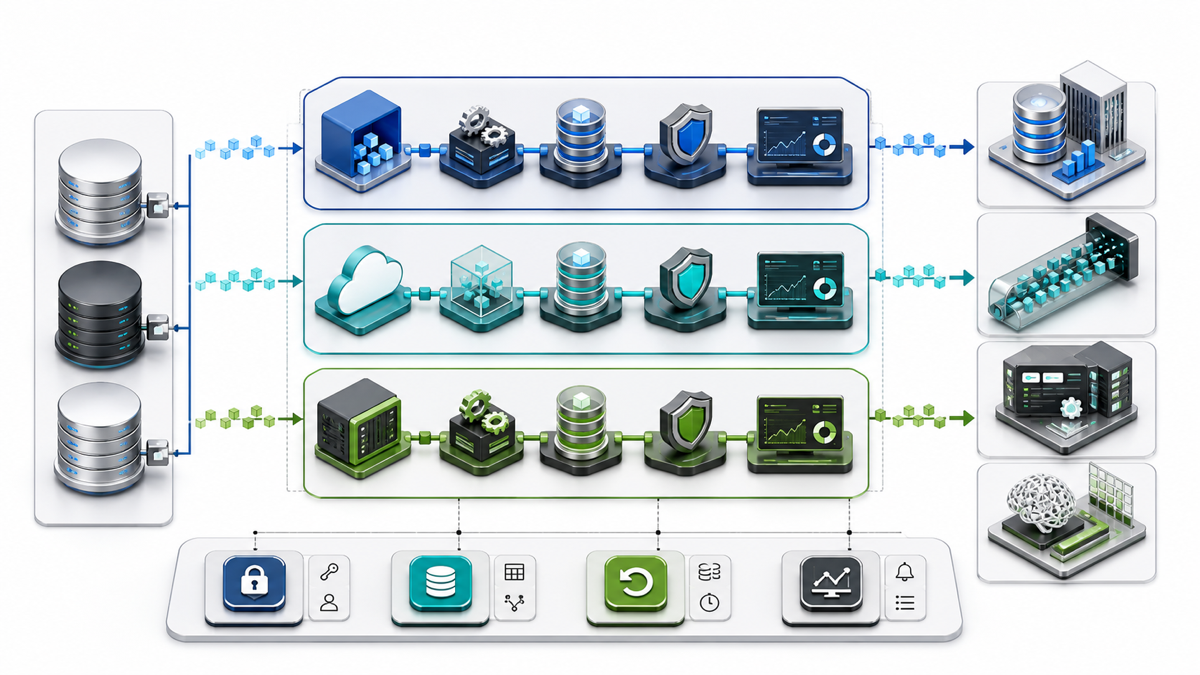
What is the best change data capture tool for an enterprise?
There is no universal best CDC tool for every enterprise. The right shortlist depends on capture method, source coverage, deployment and data-residency boundaries, latency, snapshot and recovery behavior, schema evolution, observability, security, and the team that will operate it. Evaluate representative products against one production pipeline and failure scenario, not a feature checklist alone, because operational ownership often determines the real lifecycle cost.
Technical Guide Reading time: 12 minutes
Executive Summary
Change Data Capture tools all promise fresher data, but they do not solve the same operating problem. An open-source connector framework, a cloud migration service, a managed warehouse ingestion product, and a customer-controlled enterprise replication platform can all use CDC while placing very different responsibilities on the buyer.
The most important decision is therefore not which vendor has the longest connector list. It is which operating model fits the systems, risk boundaries, recovery requirements, and engineering capacity of the organization.
For a useful comparison, begin with the production workload. Identify the source database, target systems, required latency, acceptable source impact, data residency boundary, expected schema changes, maximum recovery window, and the team that will own the pipeline at 2 a.m. Only then should a feature comparison begin.
What should an enterprise evaluate before comparing CDC tools?
A credible evaluation should cover the full data path, not only the log reader. The following dimensions expose the differences that tend to appear after a proof of concept becomes production infrastructure.
| Evaluation dimension | Questions to answer | Why it matters |
|---|---|---|
| Capture method | Does the tool read native transaction logs, poll tables, use triggers, or combine methods? | The method affects source load, delete capture, ordering, latency, and operational permissions. |
| Deployment and data boundary | Where do capture, processing, temporary storage, logs, metadata, and control services run? | Data residency and security requirements apply to the entire path, not just the final destination. |
| Source and destination coverage | Are the exact database versions, editions, data types, DDL events, and target write modes supported? | A logo on a connector page does not prove support for a specific production configuration. |
| Recovery | How are snapshots coordinated with log positions? Can operators pause, resume, replay, resnapshot, and reconcile? | Recovery behavior determines whether an incident becomes a controlled operation or a data-loss event. |
| Schema evolution | Which additive and breaking changes are detected, propagated, blocked, or escalated? | Unmanaged schema changes are a common cause of silent drift and downstream failures. |
| Security and governance | How are credentials, masking, encryption, lineage, audit events, roles, and policy controls handled? | Production replication touches sensitive operational systems and often crosses organizational boundaries. |
| Observability | Can teams monitor source lag, target lag, throughput, retries, backlog, schema events, and delivery state? | A pipeline that only reports "running" can still be hours behind or dropping required changes. |
| Operational ownership | Who patches connectors, scales workers, tunes buffers, handles upgrades, and responds to incidents? | The owner and support model frequently determine lifecycle cost more than initial license price. |
Which CDC operating model fits your team?
Most enterprise CDC options fall into four operating models. Products can span more than one model, so evaluate the actual deployment you intend to run.
Open-source CDC components
Open-source components provide control and extensibility. Debezium, for example, can run through Kafka Connect, Debezium Server, or embedded engine patterns. That flexibility also means the buyer owns architecture, deployment, upgrades, security hardening, monitoring, scaling, sink behavior, and incident response unless a commercial distribution or services partner takes on those responsibilities.
Cloud-managed connectors and migration services
Managed services reduce infrastructure work and can be effective when sources and targets already sit inside the provider's operating model. The evaluation must still cover networking, data movement boundaries, supported CDC semantics, target behavior, cost at sustained change volume, and what happens when a connector or target falls behind.
Hybrid control-plane and customer-data-plane services
Hybrid services keep some processing inside a customer environment while retaining a vendor-operated control plane. This can reduce data movement outside the secure perimeter, but buyers should document exactly which metadata, logs, credentials, and operational signals leave that perimeter.
Customer-controlled enterprise replication platforms
These platforms run capture and processing within customer-controlled infrastructure and package more operations than a component framework. They are most relevant when source impact, deployment control, heterogeneous databases, recovery, auditability, and support accountability matter together.
How do representative CDC tools differ?
The following table is a shortlist framework, not a ranking. Product packaging and connector capabilities change, so verify every requirement against current official documentation and a workload-specific proof of concept.
| Tool or approach | Primary operating model | Deployment and data boundary | Best evaluation fit | Main ownership consideration |
|---|---|---|---|---|
| Debezium | Open-source log-based CDC components | Self-managed through Kafka Connect, Debezium Server, Kubernetes, or embedded patterns | Teams that already operate Kafka or want deep connector control and extensibility | The team owns the surrounding runtime, destinations, hardening, monitoring, upgrades, and recovery procedures. |
| Confluent Cloud connectors | Fully managed connectors integrated with Confluent Cloud | Cloud-managed Kafka and connector service with provider networking and identity options | Kafka-centric organizations that want managed source and sink connectivity | Validate connector-specific semantics, network boundaries, Kafka operating costs, and downstream consumer ownership. |
| AWS Database Migration Service | AWS-managed migration and ongoing replication service | Runs in AWS using replication instances or serverless migration resources | AWS-centered database migration, modernization, and ongoing replication workloads | Teams still own task configuration, mapping rules, monitoring, target tuning, validation, and recovery runbooks. |
| Fivetran Hybrid Deployment | SaaS control plane with customer-hosted processing agent | Pipeline processing runs in the customer's environment while operational metadata and logs support the Fivetran control plane | Organizations seeking managed operations while keeping data processing within a private network | Confirm plan availability, metadata boundaries, connector coverage, usage economics, and local infrastructure responsibilities. |
| Airbyte | Open-source replication platform with cloud and self-managed editions | Deployment choice depends on edition; connector behavior varies by source and destination | Teams prioritizing a broad connector ecosystem, customization, and self-managed flexibility | Validate connector-specific CDC maturity, support level, upgrade cadence, state management, and production operations. |
| Oracle GoldenGate | Enterprise log-based capture and heterogeneous replication | Customer-managed or Oracle service patterns, with strong integration into Oracle database environments | Oracle-intensive estates and complex heterogeneous replication requirements | Plan for specialized administration, topology design, database configuration, monitoring, and commercial licensing. |
| Deltaplex | Customer-controlled enterprise real-time data integration platform | Deploy on-premises, in a private cloud or VPC, or across hybrid infrastructure so data processing remains under customer control | Regulated and operational workloads that need low-impact CDC, controlled deployment, recovery, schema handling, monitoring, and audit support | Validate exact source and target coverage in a production-shaped pilot and define the shared operating model with Deltaplex support. |
When is open-source CDC the right choice?
Open-source CDC is a strong choice when the organization already has a durable platform team, standardizes on Kafka or another supported messaging layer, and values control more than packaged operations. It can also be appropriate when connector behavior must be extended in code or when the CDC stream is itself a product primitive.
The decision should include the surrounding system. A Debezium connector is not the same thing as a complete enterprise replication service. Production teams must design snapshot storage, offset durability, topic configuration, sink delivery, schema management, secrets, monitoring, upgrades, high availability, and recovery. Those responsibilities are manageable, but they must be budgeted explicitly.
When is a managed CDC service the better fit?
A managed service is attractive when the supported source-to-target path matches the requirement, the organization accepts the service's control and data boundaries, and reducing infrastructure ownership is more valuable than deep customization. It is often efficient for warehouse ingestion, cloud migration, and standardized connectors.
Buyers should still test failure behavior. Ask how the service handles long source outages, expired logs, target throttling, breaking schema changes, large transactions, resnapshotting, and reconciliation. Managed infrastructure reduces work; it does not remove the need to define correctness.
When Deltaplex is a strong fit
Deltaplex is designed for enterprises that need a production data movement layer without sending operational data through a cloud-only processing path or assembling the full platform from separate open-source components.
- Core databases must be captured through low-impact, log-based CDC.
- Data processing must run on-premises, in a customer VPC, or across hybrid infrastructure.
- Security and data residency teams need clear control over where data moves and where it is processed.
- Operators need centralized visibility into lag, throughput, failures, retries, schema events, and recovery state.
- Schema handling, masking, routing, replay, and audit support must be part of one operating model.
- The organization wants accountable product support without making Kafka and connector operations a permanent internal platform project.
When Deltaplex may not be the best fit
A smaller service may be more appropriate for a temporary one-time migration, a low-risk daily batch, or a single supported SaaS-to-warehouse connector with no deployment-control requirement. A self-managed open-source stack may also be the better choice when the organization already operates that stack as a strategic platform and needs unrestricted code-level extension.
The goal of a shortlist is not to force every workload into the same product. It is to match operational requirements to the simplest model that can meet them reliably.
What should a CDC proof of concept test?
A useful proof of concept should resemble production and include failure, not just a successful happy-path sync.
| Test area | Scenario | Evidence to collect |
|---|---|---|
| Initial load | Snapshot a representative large table while writes continue | Source impact, duration, consistency boundary, duplicates, and missed-change checks |
| Steady-state CDC | Run realistic insert, update, delete, and transaction patterns | End-to-end latency, throughput, ordering, and target correctness |
| Target slowdown | Throttle or pause the destination | Backpressure behavior, backlog growth, storage use, alerts, and recovery time |
| Schema change | Add a column, change a type, and introduce one breaking change | Detection, classification, propagation, blocking behavior, and operator guidance |
| Restart and replay | Stop capture and delivery components at different points | Checkpoint durability, duplicate handling, data loss, and resume procedure |
| Security review | Inspect credentials, network paths, logs, temporary storage, and permissions | Data flow diagram, least-privilege roles, encryption, masking, and audit records |
| Operations | Hand an incident to the intended on-call team | Time to diagnose, available telemetry, runbook completeness, and support escalation |
How should teams compare lifecycle cost?
Compare the same operating boundary for every option. A connector license, a managed service bill, and an internal platform estimate are not equivalent unless they include the same responsibilities.
- Initial delivery: source preparation, networking, connector configuration, target mapping, testing, and validation.
- Platform operations: compute, storage, messaging, high availability, upgrades, backups, and disaster recovery.
- Engineering ownership: connector maintenance, schema incidents, performance tuning, security reviews, and on-call support.
- Usage economics: changed rows, data volume, tasks, connectors, throughput, environments, and retained history.
- Risk: source impact, missed changes, recovery duration, compliance exposure, and opportunity cost when specialist engineers maintain plumbing.
Use a three-year model and document assumptions. The least expensive proof of concept can become the most expensive operating model if it transfers unplanned work to a scarce platform team.
Common questions
Is log-based CDC always the best capture method?
No. Log-based CDC is usually the strongest choice for low-latency operational replication with delete capture and limited table scanning, but it requires database-specific log access and operational controls. Polling can be sufficient for low-risk, low-frequency workloads.
Should connector count decide the shortlist?
No. Confirm the exact source version, target write mode, data types, schema behavior, and support level. One production-ready connector for the required path is more valuable than hundreds of unrelated connectors.
Does self-hosted mean no data leaves the environment?
Not necessarily. Separate the data plane, control plane, logs, telemetry, metadata, credentials, and support channels. Document every outbound flow before approving a deployment model.
Can a CDC tool guarantee exactly-once delivery?
End-to-end correctness depends on source positions, checkpoints, transport, target write semantics, idempotency, and recovery. Evaluate the final target state under retries and partial failures rather than accepting a connector-level label.