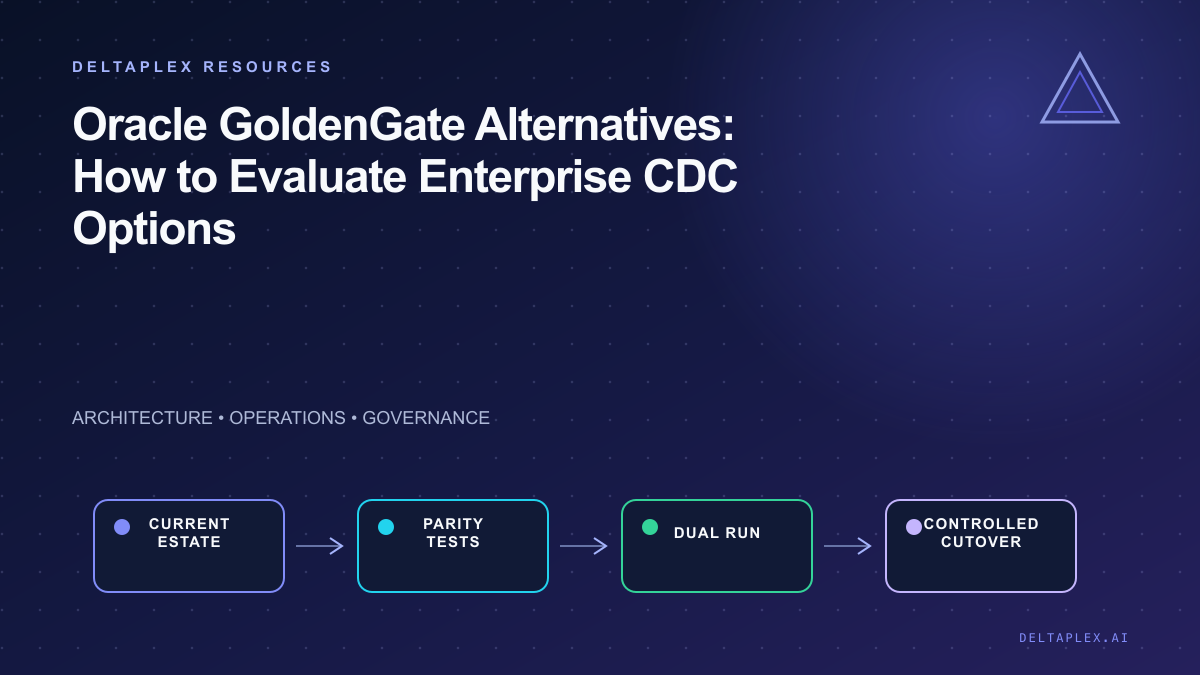
How should enterprises evaluate Oracle GoldenGate alternatives?
Oracle GoldenGate alternatives fall into open-source CDC frameworks, cloud-managed migration or replication services, commercial CDC platforms, and customer-controlled platforms. The right shortlist depends on Oracle topology, targets, transaction semantics, recovery requirements, and operating boundaries. Use official support evidence to build the shortlist, then run the same failure-focused PoC; do not decide from feature checklists or unverified price and speed claims.
Why do enterprises evaluate GoldenGate alternatives?
Most evaluations begin with a business event: a renewal, a platform modernization, a cloud or lakehouse program, a new regional boundary, a shortage of specialist skills, or a requirement to distribute Oracle changes to more consumers. These are valid reasons to examine the architecture. They are not, by themselves, evidence that the current platform is failing.
Separate the trigger from the decision. A stable estate with deep Oracle-specific requirements, trained operators, mature runbooks, and predictable consumers may be safer to retain. A growing estate with heterogeneous targets, expensive operational coupling, or a deployment boundary that no longer fits may justify coexistence or replacement. The objective is not to find a universal winner; it is to reduce risk for a defined workload.
Which requirements define a credible shortlist?
Begin with source reality. Record Oracle Database version and edition, single-instance or clustered topology, container and pluggable database layout, standby configuration, redo rate, peak transaction size, table count, data types, DDL frequency, and recovery procedures. A solution that supports a simple source may not support the production topology in the same way.
Then define targets and semantics. List every warehouse, stream, lakehouse table, object store, operational database, and application consumer. Specify which need low latency, transaction boundaries, ordering, before images, deletes, DDL, fan-out, replay, or bidirectional conflict handling. State RPO, RTO, source-impact limits, network boundaries, regions, and support ownership.
| Requirement | Hard gate or preference? | Evidence to collect |
|---|---|---|
| Oracle topology and version | Hard gate | Documented support plus PoC on matching topology |
| Transaction correctness | Hard gate | Failure and reconciliation results |
| Recovery within log retention | Hard gate | Observed restart, replay, and catch-up |
| Residency and access boundary | Hard gate | Data-flow and support-access diagram |
| User interface and existing skills | Weighted preference | Operator assessment |
| Procurement and commercial model | Weighted preference | Comparable three-year cost model |
Write each hard requirement as a testable statement. “Supports RAC” is too vague. A useful statement identifies the topology, failover action, expected source position, maximum recovery window, and required evidence after promotion.
What categories of GoldenGate alternatives exist?
Categories are more useful than a “top tools” list because they expose operating trade-offs.
- Oracle-native or adjacent approaches can address standby, disaster recovery, or Oracle-to-Oracle continuity. They are not automatically substitutes for heterogeneous CDC, selective transformation, or broad downstream fan-out.
- Open-source CDC frameworks provide extensibility and transparent implementation, while placing integration, upgrades, connector compatibility, state management, and support largely on the operating team.
- Cloud-managed migration or replication services can reduce infrastructure work inside a supported cloud boundary, but coverage, recovery behavior, networking, and long-running operational suitability must be checked per source and target.
- Commercial CDC platforms package connectors, operations, and support. Their deployment and data boundaries vary, so the category label is not enough.
- Customer-controlled platforms run core components in a customer-designated environment. They may fit residency or private-network requirements, but the customer and vendor still need a precise operating RACI.
A disaster-recovery standby and heterogeneous CDC solve different primary problems. A standby maintains a recoverable database copy and can support role transition. CDC converts committed changes into a stream or applies selected changes to other systems. Some architectures use both.
How should options be compared on Oracle-specific requirements?
Oracle redo-based capture depends on source configuration. Supplemental logging can add identifying column information to redo, and the chosen level affects both correctness needs and redo volume. The evaluation should therefore test source logging, privileges, archived-log retention, key selection, large transactions, special data types, and schema changes under the intended version and topology.
| Oracle area | Questions to answer | PoC evidence |
|---|---|---|
| Clustered source | How are threads, instance changes, and source failover handled? | Observed continuity and new checkpoint |
| Multitenant source | Which containers and pluggable databases are supported, and where is state held? | Scoped capture and restart test |
| Supplemental logging | Which keys or columns must be logged, and what source overhead results? | Configuration plus redo and workload baseline |
| DDL and types | Which changes are detected, represented, applied, paused, or rejected? | Schema test matrix |
| Initial load | How is the consistency point tied to ongoing redo capture? | Boundary transactions and reconciliation |
| Recovery | What happens after process, host, network, target, or source failure? | Failure-injection results and runbook |
Use four evidence states: Supported, with current documentation and a passing test; Conditional, when behavior depends on version, edition, topology, configuration, or manual steps; Not documented, when public evidence is absent; and Planned, which must not count as current capability. Not documented is not the same as unsupported, but it is not sufficient for a production decision.
Do not compare published throughput from different environments. Hardware, redo distribution, transaction size, transformations, durability, network path, and target commit behavior can change results materially. Run the same workload and publish the method internally.
How do deployment and operating models change the decision?
The software location, the data path, and the operating owner are separate choices. A service can have a managed control plane and customer-side data plane. A platform can run in a private environment while the customer still receives vendor-assisted upgrades. Draw the data, control, metadata, telemetry, key, and support paths for each candidate.
Create a RACI for installation, capacity, patches, version certification, credential rotation, monitoring, on-call, replay, reconciliation, source failover, security evidence, and upgrades. “Managed” does not remove ownership for source health, target capacity, data quality, or business validation. “Self-hosted” does not reveal whether support and recovery tooling are adequate.
Compare three-year cost on the same basis: software, infrastructure, storage, network, log retention, non-production environments, monitoring, specialist labor, on-call, professional services, dual run, migration, rollback, and exit. Avoid unverified list-price comparisons or assumptions that open-source software has zero operating cost.
What are the major migration and coexistence risks?
Migration is a state transition, not a connector swap. The new path needs a consistent starting point tied to Oracle redo, a compatible event or target representation, and a method to prove that the old and new paths describe the same committed changes.
- Inventory. Map source objects, filters, mappings, transformations, trail or checkpoint dependencies, consumers, service objectives, and owner contacts.
- Non-critical pilot. Choose a representative domain without making it the easiest possible table. Test source impact, initial load, DDL, and failure recovery.
- Parallel capture. Run both paths, isolate their target writes where necessary, and compare keys, counts, checksums, control totals, order, and latency.
- Consumer-by-consumer cutover. Move one bounded consumer, monitor its business results, and preserve a clear rollback path.
- Stabilize and decommission. Keep the old path for an agreed window, close exceptions, then remove jobs, accounts, storage, and operational dependencies.
Parallel capture can create duplicates or conflicting applies if both paths write to the same target. Assign one authoritative writer or design an explicit deduplication boundary. Preserve the old position and retained logs long enough to execute the approved rollback, while recognizing that retention consumes storage and has an operational limit.
| Migration risk | Control | Rollback trigger |
|---|---|---|
| Boundary gap | Tie snapshot to redo position and reconcile boundary keys | Any unexplained missing committed change |
| Duplicate apply | Single writer or idempotent target contract | Business totals diverge |
| Schema mismatch | Versioned contract and DDL test | Unsupported production change |
| Recovery exceeds retention | Headroom alert and tested resnapshot plan | Recovery point no longer available |
| Consumer regression | Phased cutover and side-by-side validation | Defined business SLO breach |
When should a team replace, coexist, or stay?
| Decision | Signals that support it | Questions before approval |
|---|---|---|
| Replace | The new platform passes all hard gates, materially fits the future target estate, and migration risk is bounded | Can the team recover and operate it without hidden dependency? |
| Coexist | Different consumers need different semantics or migration must be gradual | Who owns duplicate prevention, reconciliation, and the end date? |
| Stay | The current estate is stable, requirements are deeply Oracle-specific, and change risk exceeds benefit | Are cost and skill risks still acceptable over the planning horizon? |
Record the decision and its assumptions in an architecture decision record. Revisit it when Oracle versions, target strategy, regulatory boundaries, workload, or team capability changes. Do not count roadmap promises as current evidence.
How should the initial load and cutover boundary be validated?
The hardest migration defect often appears at the boundary between historical state and ongoing redo. The new path needs a consistency point that can be related to a source position, while source applications continue to commit transactions. Test records immediately before, at, and after that boundary. Include inserts, updates, deletes, key changes, a large transaction, and a transaction spanning several tables.
Validation needs more than row counts. Compare key coverage, key-range checksums, control totals, delete state, and selected business invariants. If transformations change the target shape, define a canonical comparison rather than expecting byte equality. Record which schema version interprets each field and how the new path represents unsupported or incompatible changes.
| Cutover checkpoint | Evidence required | Rollback question |
|---|---|---|
| Snapshot started | Consistency marker and source position | Can the snapshot restart without losing the marker? |
| Streaming caught up | Backlog, freshness, and boundary reconciliation | Are required redo records still retained? |
| Consumer switched | Business result and target ownership | Can reads return to the old path safely? |
| Old path stopped | Final checkpoint and retained rollback state | How are new changes handled if rollback occurs? |
| Old platform retired | Closed exceptions, removed access, archived evidence | Has every dependency been decommissioned? |
Do not cut over because both dashboards show similar lag. They may measure different boundaries. Use one independent marker and one reconciliation method across both paths. For a high-risk domain, hold the consumer switch until the new path has survived a target outage, a process restart, and the intended Oracle source failover while parallel comparison remains available.
How can teams preserve option value and avoid a second lock-in?
A replacement project can reproduce the same dependency under a different operating model. Preserve option value by keeping source-to-target contracts explicit: event identity, key, source position, transaction metadata, schema version, delete semantics, timestamps, and error policy. Downstream consumers should depend on that contract, not on undocumented trail fields or a platform-specific administrative database.
Exportable operational state matters as well. Confirm that the team can retrieve checkpoints or equivalent positions, configuration, schema history, audit events, reconciliation results, and pipeline inventory in a documented form. This does not guarantee a zero-effort future migration, but it reduces discovery risk and makes an exit plan testable.
- Use infrastructure and configuration records that can be reviewed outside the administration interface.
- Keep business transformations versioned and owned separately from connector plumbing.
- Define retention and export for operational evidence before a contract ends.
- Run a small exit exercise during the pilot: stop one non-critical flow, export its state, and rebuild or redirect it.
- Include decommissioning of credentials, network paths, retained logs, and old consumers in the acceptance criteria.
Option value also comes from an honest coexistence boundary. Some Oracle workloads may remain on GoldenGate because they use proven Oracle-specific behavior, while heterogeneous analytical or event consumers move elsewhere. A mixed estate is acceptable when ownership, monitoring, reconciliation, and the reason for each path are explicit. It becomes a problem when coexistence is an unowned transition with no review point.
Fit, non-fit, and the next step
A replacement evaluation fits organizations with a clear modernization trigger, heterogeneous targets, changing operating boundaries, or an evidence-backed need to reduce current complexity. Coexistence fits phased consumer migration or distinct workload classes. Staying fits a stable, well-operated estate when the current platform meets future requirements and migration adds more risk than value.
No CDC platform should be treated as a drop-in replacement until its Oracle versions, topologies, types, DDL behavior, recovery semantics, deployment boundary, and target combinations are verified. If Deltaplex is being considered, place it in the same requirements matrix and run the same Oracle failure tests rather than relying on broad platform statements.
The next step is to complete the workload inventory, designate hard gates, choose a non-critical but representative domain, and approve rollback criteria before starting parallel capture. Use the enterprise CDC PoC scorecard and the CDC architecture guide to structure the evidence.
Frequently asked questions
What is the best alternative to Oracle GoldenGate?
There is no universal best alternative. The right choice depends on Oracle version and edition, clustered or multitenant topology, standby arrangement, target systems, transaction and DDL requirements, recovery objectives, deployment boundary, operating skills, and migration risk. Build a shortlist from current support evidence, then run the same workload and failure plan for every candidate. The best decision may be replacement, selective coexistence, or staying with the current estate. Write the decision as an architecture record with assumptions and a review trigger. A credible shortlist also states what each option will not do, which requirements are conditional on version or configuration, and which capabilities exist only on a roadmap. Compare initial-load consistency, redo retention, large transactions, DDL, source failover, target outage, and operator recovery under one evidence model before commercial scoring begins.
Can open-source CDC replace GoldenGate?
It can fit some workloads when the framework supports the exact Oracle topology, data types, transaction semantics, initial-load boundary, target behavior, and source-failover path. The organization must also own connector integration, version compatibility, state storage, upgrades, monitoring, security, recovery, and 24×7 support. Software availability is not the same as production readiness. A failure-focused PoC and an honest operating-cost model are essential. Include key-person risk and the cost of certifying upgrades in that model.
Is a database standby architecture an alternative to Oracle GoldenGate?
Not as a general category. A database standby architecture primarily maintains a recoverable copy for availability, data protection, and disaster recovery, often by transporting and applying database logs. GoldenGate supports logical change replication and heterogeneous distribution use cases. The patterns can overlap in continuity or reporting scenarios and can complement each other, but a standby architecture does not automatically replace selective CDC, transformation, fan-out, or heterogeneous targets. Evaluate the required end state before comparing products.
How can a team migrate without data loss?
Tie the initial state to a defined redo position, preserve source-log headroom, run old and new paths in parallel, and reconcile counts, keys, checksums, control totals, ordering, and latency. Cut consumers over in bounded stages, assign one authoritative writer, and preserve an approved rollback window. Test process failure, target outage, network interruption, and the intended source-failover path before production. No migration method should be called lossless without observed evidence. Define who can invoke rollback and how changes created during rollback are handled.
Should GoldenGate and a new CDC platform run in parallel?
Parallel capture is often useful for validation and phased consumer migration. It also introduces duplicate, ordering, target-write, ownership, and cost risks. Prevent both paths from applying conflicting changes, isolate targets where possible, assign an authoritative writer, use a shared comparison method, and define rollback criteria. Coexistence needs a named owner, a retention plan, and either a planned end date or an explicit long-term architecture decision. Monitor both source overhead and operational burden during the overlap.
How should GoldenGate alternative costs be compared?
Use a common three-year model covering software, infrastructure, storage, network, redo and trail retention, non-production environments, monitoring, specialist labor, on-call, professional services, support, migration, dual run, rollback, and exit. Compare the same availability and recovery design for every option. Avoid unverified list prices, assumed open-source savings, and performance numbers from different workloads. Record uncertainty as a range rather than hiding it in one total. Recalculate under growth, regional redundancy, and major-incident scenarios.