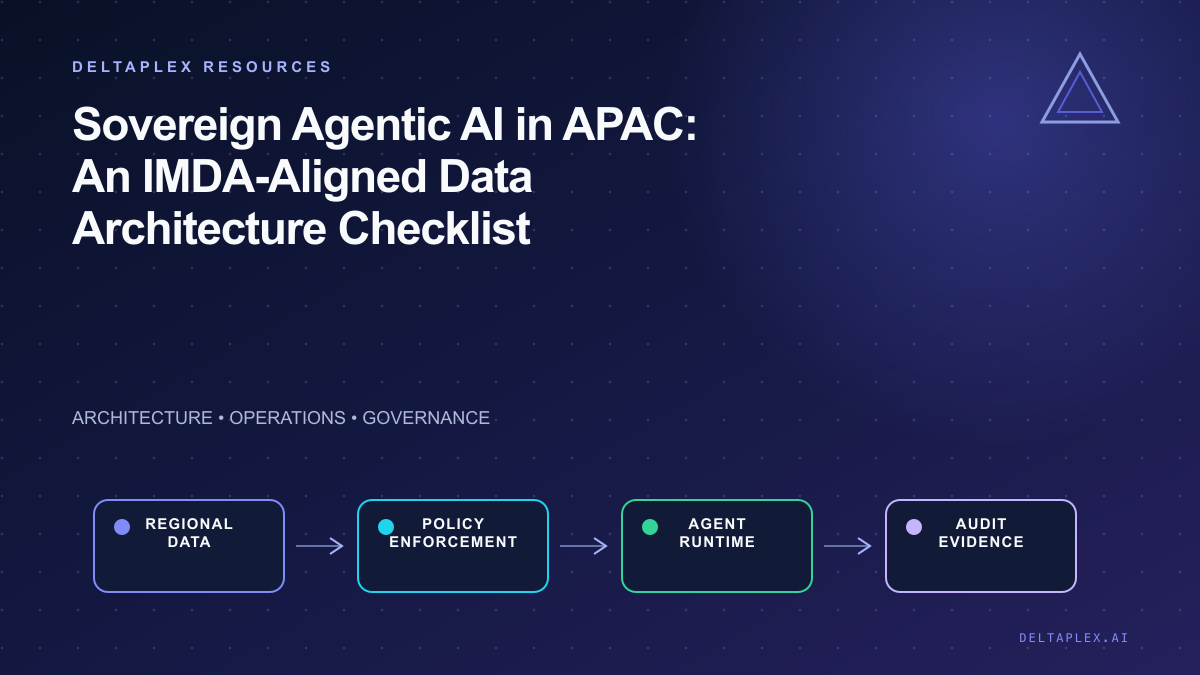
What makes agentic AI sovereign beyond regional data residency?
Sovereign agentic AI means an organization can control and evidence where agent data is processed, who and what can access it, which tools and actions are permitted, how authority is delegated, and how incidents are contained. Regional hosting alone is insufficient because model calls, telemetry, backups, support access, subprocessors, and downstream tools may cross other boundaries.
This article provides architecture and governance guidance, not legal advice. Data-residency, sovereignty, localization, privacy, and sector obligations differ by jurisdiction and use case.
How is sovereign agentic AI different from data residency?
Data residency asks where data is stored or processed. Sovereignty asks a wider set of questions: who can access it, whose policies control it, which external dependencies can receive it, whether authority can be revoked, and whether the organization can prove what happened.
That difference becomes important when software can act. An agent may receive a prompt, retrieve context, use memory, call a model, invoke a tool, send data to another agent, request approval, and change an external system. Every step creates a location, identity, policy, and evidence question. A database hosted in Singapore does not make the complete workflow sovereign if telemetry, support logs, model requests, backups, or tool calls are processed elsewhere.
“Sovereign” should therefore be treated as an end-to-end control objective, not a cloud-region label. The organization should map the data plane, control plane, identity plane, model path, tool path, operations path, and evidence path. It should also distinguish technical control from legal conclusion: an architecture can support an obligation, but only qualified counsel and the relevant authority can determine how the law applies.
How can teams translate Singapore's agentic AI framework into controls?
Singapore's Model AI Governance Framework for Agentic AI provides a practical structure for responsible deployment. It was launched in January 2026 and updated in May 2026 with additional practices and case studies, including attention to multi-agent systems, third-party agents, and automation bias. It is a governance framework, not a universal certification or a substitute for applicable law.
Assess and bound risks before deployment
Start with the use case, not the model. Evaluate the sensitivity of the data, the agent's autonomy, the impact of an error, the reversibility of an action, and the number of systems or people affected. Bound access to data, tools, geography, time, and spend. A customer-service assistant that drafts a response is not the same risk as an agent that changes account permissions or initiates a payment.
Make humans meaningfully accountable
Assign a business owner, technical owner, risk approver, and incident owner. Human involvement should be placed at meaningful checkpoints, not added as a decorative click. Approvers need a readable preview of the target, inputs, expected effect, and uncertainty. The system should record approval, refusal, override, and escalation.
Apply lifecycle controls
Controls should cover design, testing, deployment, monitoring, change, incident response, and retirement. A new model, prompt, tool, sub-agent, policy, or data source can change the risk. Third-party and multi-agent delegation must not expand authority beyond the original grant.
Enable responsible end-user behavior
Users should know when they are interacting with an agent, what it can do, where its limits are, and how to correct or escalate an outcome. Training should address automation bias so that a human approver does not become a rubber stamp for a machine-generated recommendation.
How should teams bound an agent's powers, data, tools, geography, and time?
A usable boundary is explicit enough to enforce outside the model.
- Powers: separate read, recommend, draft, execute, and approve. Do not grant execute because the agent can describe the action.
- Data: classify information, limit the purpose, expose only required fields and entities, and set retention and deletion rules.
- Tools: allowlist servers and operations, lock versions, constrain parameters, restrict network destinations, and set rate and spend limits.
- Geography: map storage, processing, inference, logging, backup, disaster recovery, support access, sub-agents, and third-party APIs.
- Time: use short-lived credentials, session and task boundaries, approval expiry, and emergency revocation.
These controls should be enforced by identity, policy, gateway, network, and execution services. A system prompt that says “do not access sensitive data” is guidance, not an access-control mechanism.
Which actions need human approval?
No single approval threshold works for every organization. A useful method is to classify actions by data sensitivity, autonomy, impact, reversibility, external reach, and regulatory significance.
| Tier | Typical action | Control pattern | Example evidence |
|---|---|---|---|
| 1: Low | Read public or low-sensitivity information | Automatic execution with sampling | Identity, source, purpose, result |
| 2: Moderate | Reversible internal update within a threshold | Automatic within limits; post-action review | Policy version, before/after state, rollback |
| 3: High | Sensitive data, external communication, financial or access change | Approval before execution | Human preview, approver, expiry, outcome |
| 4: Critical | Irreversible, safety-critical, or strongly regulated action | Dual approval, specialized workflow, or prohibition | Independent approval, segregation of duties, full reconstruction |
The workflow also needs a response to approval timeout, refusal, conflict of interest, and emergency stop. An approval should expire when the context that supported it is no longer current. The exact threshold is an institutional and legal decision; the framework helps organizations structure that decision but does not prescribe one universal answer.
What decision lineage and audit evidence should be captured?
Decision evidence should connect four groups of facts.
- Actors: end user, agent or workload, approver, tool, external service, and system of record.
- Context: source, entity, timestamp, freshness, classification, schema, transformation, and policy version.
- Decision: agent or model version, prompt or configuration version, tool version, risk tier, proposed action, and approval requirement.
- Outcome: approval or refusal, execution result, external state change, exception, rollback, and remediation.
The evidence must be linked and searchable, but it should not collect everything by default. Raw prompts and payloads may contain personal data, secrets, or privileged material. Use references, redaction, field-level controls, purpose-based retention, and restricted access. Avoid describing evidence as immutable unless the implementation and operating process actually support that claim.
Auditability also does not equal compliance. It gives risk, legal, audit, and operations teams the material needed to assess what occurred. Whether the evidence is sufficient depends on the jurisdiction, sector, contract, and use case.
How do on-premises, VPC, regional cloud, and hybrid deployment affect control?
Deployment location changes who operates each layer and which paths must cross a boundary. It does not remove the need for governance.
| Model | Potential strength | Control question | Common blind spot |
|---|---|---|---|
| On-premises | Direct infrastructure and network control | Who patches, monitors, supports, and recovers it? | Assuming local automatically means secure |
| Customer VPC | Customer network and cloud-policy integration | Where are management metadata and support paths? | External control-plane or telemetry flows |
| Regional managed cloud | Operational simplicity and regional service availability | Which services, backups, keys, and staff remain in-region? | Subprocessors or global support access |
| Hybrid | Keep selected sources local while using regional services | Which fields cross the boundary, in which direction, and why? | Unmapped metadata, logs, or recovery copies |
For each model, document the data plane, control plane, metadata, telemetry, encryption-key custody, remote administration, support, backup, disaster recovery, model inference, and third-party tools. On-premises can still have weak identity, unpatched systems, or remote support exposure. Regional cloud can still provide strong control if the full path is transparent and contractually governed.
What does a risk-tiered APAC architecture decision tree look like?
APAC is not one legal jurisdiction. A regional architecture should standardize the control questions while allowing local legal and sector requirements to change the answer.
- Classify the data. Does the workflow use personal, financial, health, government, security, or other sensitive information?
- Classify the action. Can the agent create an external, financial, safety, access, or irreversible effect?
- Map cross-border dependencies. Do model endpoints, tools, sub-agents, telemetry, support, or backups operate elsewhere?
- Define reconstruction needs. Must the organization reproduce the exact context, authority, and outcome after an incident or audit?
- Test continuity. What happens when a cloud service, cross-border link, model, approver, or identity system is unavailable?
Tier 1 may allow regional shared services and sampled review. Tier 2 adds workload identity, bounded tools, and versioned evidence. Tier 3 may require regional processing, pre-action approval, stronger egress controls, and tested recovery. Tier 4 may require customer-controlled deployment, segregation of duties, dual approval, specialized validation, and a manual operating mode. The labels are an internal risk model, not legal classifications.
What should security, compliance, data, and AI teams implement first?
| Team | First controls | Deliverable |
|---|---|---|
| Governance and legal | Use-case inventory, owners, applicable obligations, third-party review | Risk register and data-transfer map |
| Security | Workload identity, least privilege, segmentation, secrets, kill switch | Identity and action-boundary design |
| Data | Classification, minimization, residency map, provenance, versions | Source-to-agent and agent-to-action lineage |
| AI and product | Baseline tests, adversarial tests, authority limits, user disclosure | Release criteria and behavior evaluation |
| Operations | Monitoring, shadow mode, incident drill, rollback, reassessment | Runbook and game-day evidence |
Begin with one bounded workflow. Run it in shadow mode, then limit the users, entities, tools, and actions. Test cross-border failure, stale context, unavailable approval, malicious tool output, and emergency revocation. Reassess when any model, tool, data source, provider, or deployment boundary changes.
How should cross-border architecture choices be evaluated?
A cross-border decision should compare complete processing paths, not only primary storage. One design may keep source data in-country while sending selected fields to a regional model endpoint. Another may keep model inference local but send telemetry and support diagnostics to a global service. A third may use a regional context layer and call local tools in each jurisdiction. Each option changes the fields exposed, the party operating the control, the recovery model, and the evidence available.
Use a boundary record for every transfer. It should name the source and destination country or region, data categories, purpose, frequency, legal and policy owner, processor or subprocessor, encryption and key custody, retention, deletion, onward transfer, support access, incident notification, and fallback. Include metadata and derived data. Entity identifiers, embeddings, tool results, and logs may remain sensitive even when obvious personal fields are removed.
Architecture should support selective movement. Route only the minimum attributes required for the task, tokenize or mask where appropriate, and keep the re-identification key under separate control. A local context service can expose an approved view instead of exporting a raw source. For high-risk workflows, execute the sensitive step locally and return a bounded result. These patterns reduce exposure, but their legal sufficiency still depends on the use case and jurisdiction.
Continuity belongs in the decision. If a regional model, identity provider, or cross-border link is unavailable, determine whether the agent stops, becomes read-only, uses an approved local fallback, or routes to a human. The fallback must not bypass the very geographic and policy controls that the primary design enforces.
How should the agent supply chain be governed?
The agent supply chain includes more than the model vendor. It may include the agent framework, host application, MCP or API servers, plugins, tool providers, vector or context services, observability systems, identity services, software libraries, support partners, and subprocessors. Inventory them by workflow and data access, not only by procurement contract.
For each dependency, record ownership, version, deployment location, update channel, signing or integrity mechanism, privileges, data received, outbound connections, support access, and revocation plan. A component that can update tool descriptions or execute code deserves different scrutiny from a read-only library. New versions should enter through controlled testing, with rollback and evidence that the permissions did not expand.
Multi-agent delegation introduces a supply-chain path at runtime. The parent agent should declare the task, permitted data, authority ceiling, expiry, and expected result. The receiving agent should not inherit unrelated tools or credentials. Validate returned artifacts as untrusted input, and retain the delegation chain so an action can be traced through every participating workload.
Exit planning is a sovereignty control. Confirm that the organization can disable a provider, rotate credentials, export required evidence, delete retained data, and continue critical operations. A design is not fully controlled if termination removes the only usable audit trail or recovery path.
What runtime evidence demonstrates continuing control?
Design-time diagrams are necessary but not sufficient. Runtime evidence should show where data actually went, which identity accessed it, which policy allowed it, which tool acted, and whether the outcome remained inside the approved boundary. Compare observed network destinations, service regions, data classifications, and support sessions with the approved architecture.
Useful evidence includes workload identity issuance and revocation, policy decisions, data-transfer events, tool and agent versions, approval records, model and service endpoints, administrator access, configuration changes, backup and recovery locations, exception handling, and deletion outcomes. Link events with a common task identifier while limiting sensitive payloads.
Monitor for boundary drift: a new endpoint, subprocessor, telemetry field, model region, tool version, or support workflow. Treat these as change events that can trigger review. Periodically rehearse emergency revocation, regional outage, provider compromise, and evidence retrieval. The test is whether the organization can contain the workflow and explain the resulting state without depending solely on the affected provider.
Where does Deltaplex fit—and where does it not?
Fit
Deltaplex is relevant when an enterprise needs a controlled data path between operational sources and downstream context or analytics services. In a sovereignty review, evaluate the actual deployment rather than the product category: data plane, management plane, metadata, telemetry, support, backup, recovery, identity, and evidence boundaries all matter.
Non-fit
A real-time data integration layer is not a legal opinion, sovereignty certification, agent policy engine, model host, identity provider, approval workflow, or complete decision-evidence system. It cannot determine which jurisdiction's law applies or what authority an agent should receive.
Next step
Run a data-boundary workshop for one agent workflow. Draw every source, processing location, model call, tool, sub-agent, log, backup, support path, identity, and approval. For each arrow, record purpose, fields, geography, owner, retention, legal basis, failure behavior, and evidence. The gaps in that map are the work plan.
Frequently asked questions
Is data residency the same as AI sovereignty?
No. Residency concerns the location where data is stored or processed. Sovereignty also concerns who can access the data, whose policy governs the system, which external services receive information, how authority is revoked, how operations continue during disruption, and whether the organization can reconstruct the full workflow. A local database is only one component of that control boundary. Review model inference, identity, telemetry, support, backup, disaster recovery, third-party tools, and incident evidence as separate paths. A region label is useful evidence only when the complete operating model explains what the label covers and what it excludes.
Is Singapore's agentic AI governance framework legally binding?
The framework provides practical governance guidance for responsible agent deployment. It is not a universal certification or a substitute for the PDPA, sector rules, contractual obligations, local requirements in other jurisdictions, or legal advice. Organizations can use its risk, accountability, lifecycle-control, and user-responsibility dimensions to structure controls, then have qualified legal and compliance teams assess the actual obligations. The review should cover the specific organization, data, users, action, sector, systems, provider chain, countries, and vendors involved rather than relying on a generic regional interpretation.
Does on-premises deployment automatically make an agent sovereign?
No. On-premises deployment may increase direct infrastructure control, but identity services, remote support, model endpoints, tools, telemetry, backups, software updates, and incident operations may still introduce external dependencies. Local systems can also be poorly segmented, weakly patched, or over-privileged. Sovereignty depends on the complete operating path and the ability to enforce and evidence its boundaries. The operating team must also own patching, monitoring, recovery, key management, and emergency access. If those controls are unclear, physical location alone may reduce visibility rather than improve effective control.
What agent data may cross borders besides prompts?
Retrieved context, conversation or task memory, tool arguments and results, metadata, telemetry, support logs, backups, model requests, embeddings, safety evaluations, and incident evidence can all create cross-border paths. Teams should also inspect control-plane data and remote administration. A data-transfer map should describe each field or record type, purpose, destination, processor, retention period, and recovery copy. Include failure and support scenarios, not only normal traffic: crash dumps, diagnostic bundles, security alerts, and emergency administrator access may follow different routes. Verify contractual commitments against the actual architecture, and repeat the review when a provider, model endpoint, subprocessor, observability service, or disaster-recovery location changes.
When should a human approve an agent action?
Approval should become stronger as data sensitivity, external impact, financial value, irreversibility, safety relevance, or regulatory significance increases. A low-risk read may be sampled later; a reversible internal update may run within thresholds; a sensitive or external action may require approval before execution. The organization must define thresholds, approver authority, expiry, conflict handling, and emergency stop for its use case.
How should third-party and multi-agent systems be governed?
Map every agent, provider, tool, identity, data flow, and support dependency. Restrict delegated authority, prevent permissions from expanding as tasks move between agents, control network egress, verify tool and agent versions, and preserve end-to-end evidence. Contracts and technical controls should also address subprocessors, incident notification, location, deletion, continuity, and the process for revoking a provider or sub-agent without losing the audit trail. Test what happens when an agent delegates to an unavailable, compromised, or differently located service. The parent workflow should retain responsibility for the original purpose, authority ceiling, user disclosure, and final outcome.